Bootstrap Confidence Intervals

2025-10-15

Housekeeping

  • Coding practice due tonight
  • Midterms returned tomorrow!

Bootstrap recap

  • Sampling distribution describes how statistic behaves under repeated sampling from population

  • Typically cannot repeatedly sample from population, so we obtain bootstrap distribution as approximation of the sampling distribution of the statistic!

    1. Assume we have a sample \(x_{1}, x_{2}, \ldots, x_{n}\) from the population. Call this sample \(\boldsymbol{x}\). Note the sample size is \(n\)
    2. Choose a large number \(B\). For \(b\) in \(1,2, \ldots, B\):
      1. Resample: take a sample of size \(n\) with replacement from \(\boldsymbol{x}\). Call this set of resampled data \(\boldsymbol{x}^*_{b}\)
      2. Calculate: calculate and record the statistic of interest from \(\boldsymbol{x}^{*}_{b}\)

At the end of this procedure, we will have a distribution of resample or bootstrap statistics

Bootstrap distribution from activity

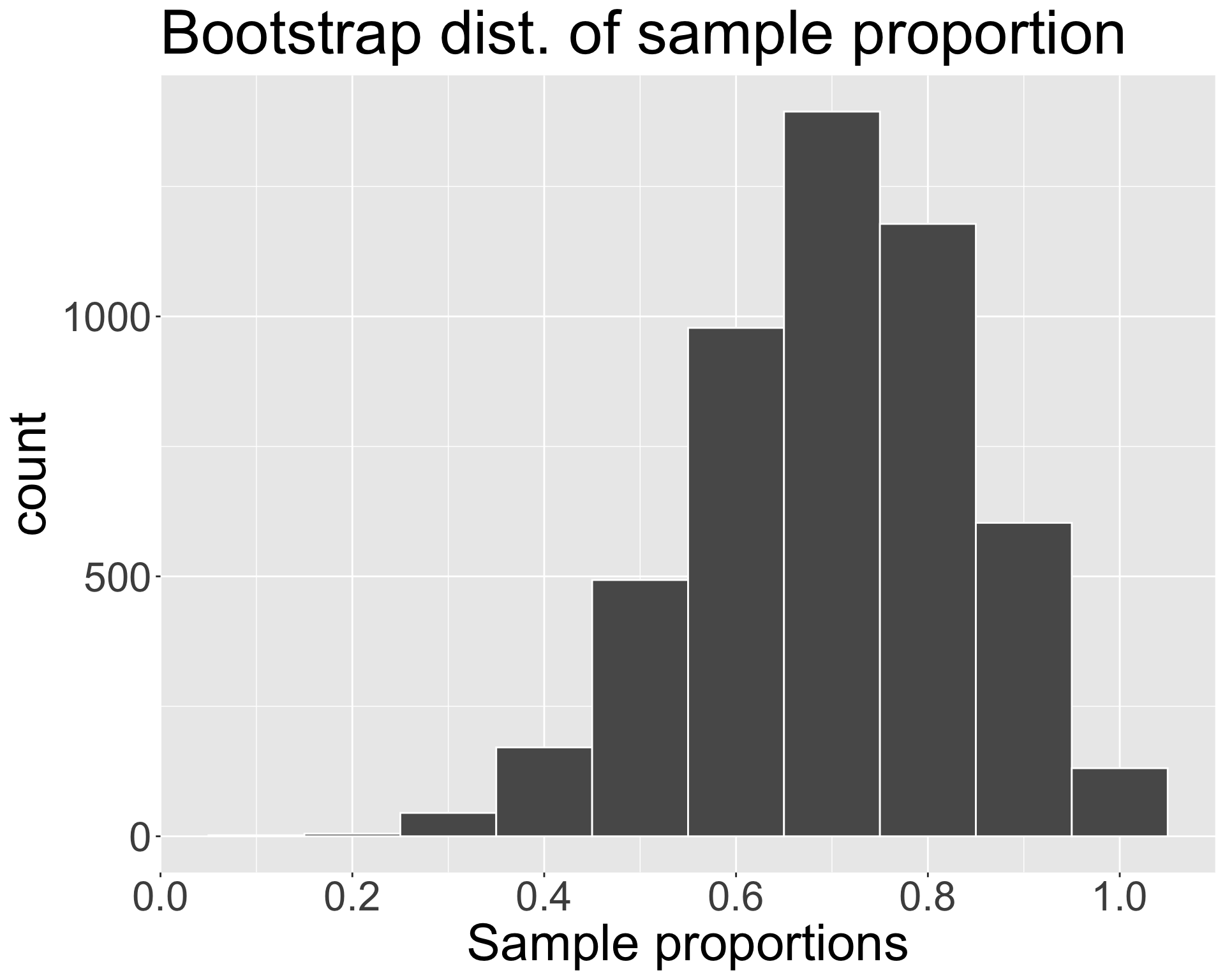
In our original sample of \(n = 10\), we had \(\widehat{p_{obs}} = 0.7\).

We have the following bootstrap distribution of sample proportions, obtained from \(B=\) 5000 iterations:

We can compare to the true sampling distribution (because it’s easy for me to re-sample from the population here):
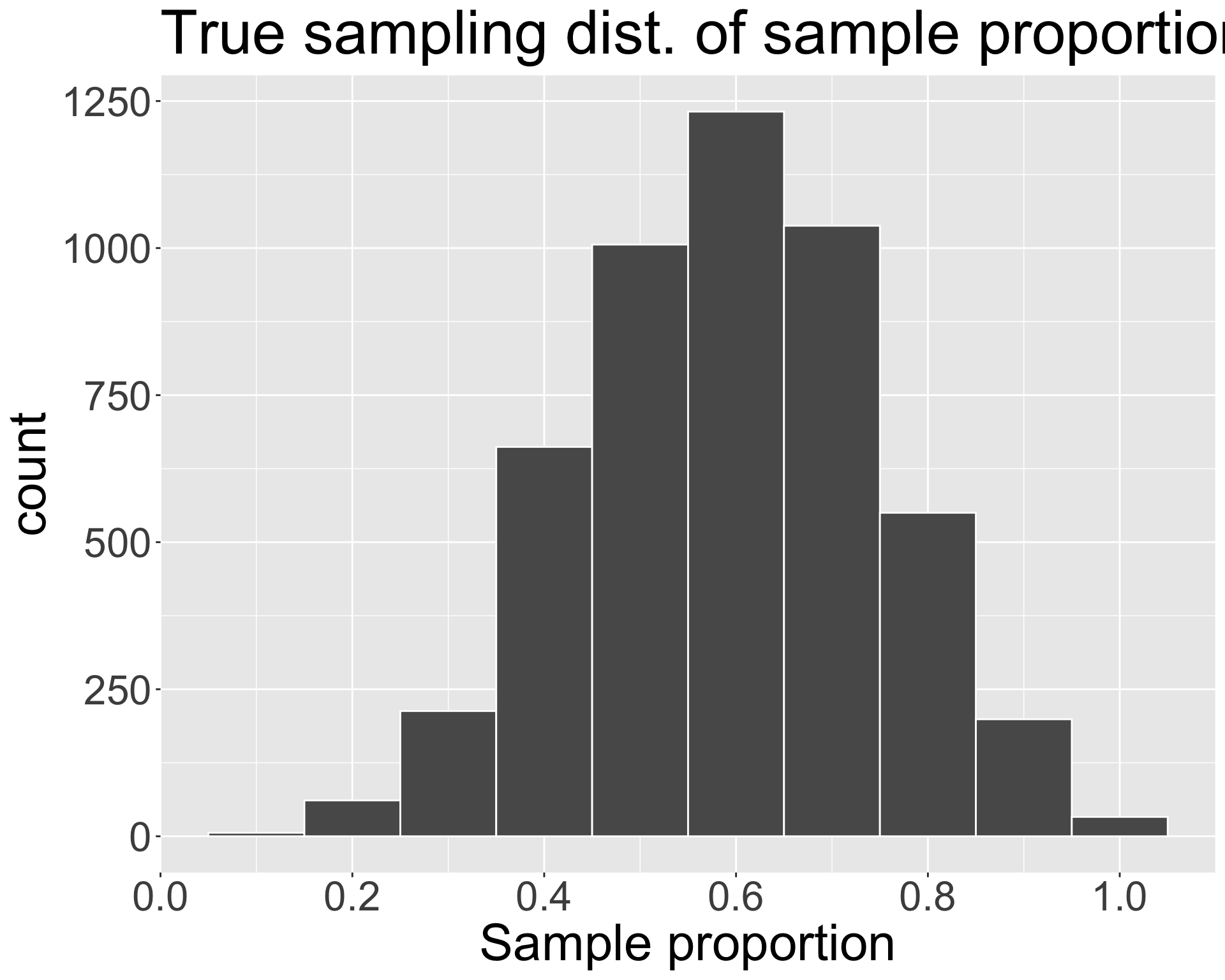
  • Notice that our bootstrap distribution isn’t a great approximation (maybe \(n = 10\) did not yield a representative sample)

Answering estimation question

  • Great…but what do we do with the bootstrap distribution?

  • Recall our research question: What proportion of STAT 201A pronounced as Middle-“berry”?

    • Could respond using our single point estimate: \(\hat{p_{obs}} = 0.7\)

    • But due to variability, we recognize that the point estimate will rarely (if ever) equal population parameter

  • Rather than report a single number, why not report a range of values?

    • This is only possible if we have a sampling distribution to work with!!

Confidence intervals

  • Analogy: would you rather go fishing with a single pole or a large net?

    • A range of values gives us a better chance at capturing the true value
  • A confidence interval provides such a range of plausible values for the parameter (more rigorous definition coming soon)

    • “Interval”: specify a lower bound and an upper bound

    • Confidence intervals are not unique! Depending on the method you use, you might get different intervals

Bootstrap percentile interval

  • The \(\gamma \times 100\)% bootstrap percentile interval is obtained by finding the bounds of the middle \(\gamma \times 100\)% of the bootstrap distribution

  • Called “percentile interval” because the bounds are the \((1-\gamma)/2\times100\) and \((1+\gamma)/2\times 100\) percentiles of the bootstrap distribution

  • If \(\gamma = 0.90\), then the bounds would be at which percentiles?
  • For our purposes, “bootstrap confidence interval” will be equivalent to “bootstrap percentile interval”
  • quantile() function in R gives us easy way to obtain percentiles: quantile(x, p) gives us \(p\)-th percentile of x

Visualizing bootstrap confidence interval
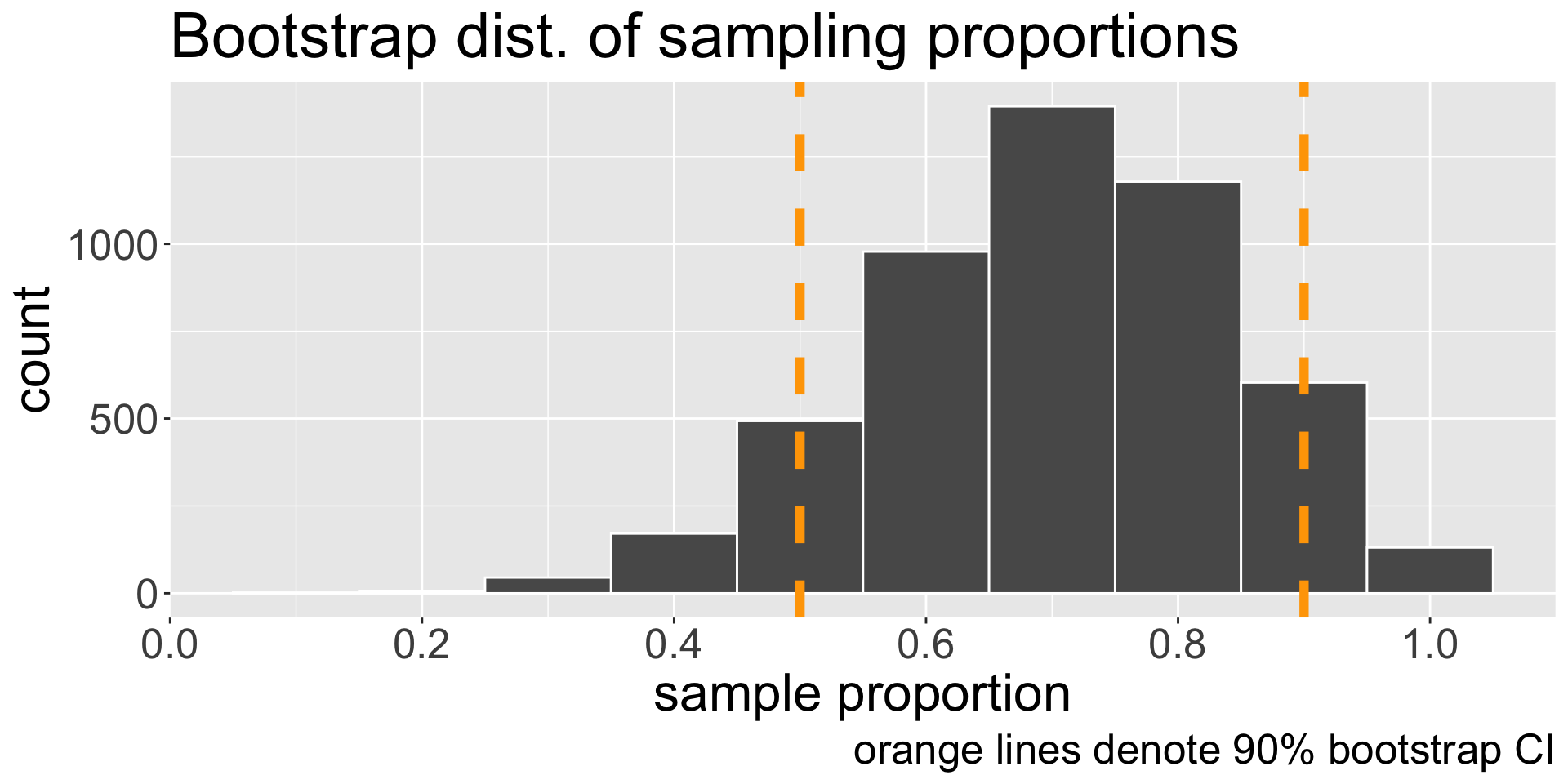
  • Our 90% bootstrap CI for \(p\): (0.5, 0.9)

Interpreting a confidence interval

  • Our 90% bootstrap CI for \(p\): (0.5, 0.9). Does this mean there is a 90% chance/probability that the true proportion lies in the interval?

    • Answer: NO

  • Remember: bootstrap distribution is based on our original sample

    • If we started with a different original sample \(\boldsymbol{x}\), then our estimated 90% confidence interval would also be different
  • What a confidence interval (CI) represents: if we take many independent repeated samples from this population using the same method and calculate a \(\gamma \times 100\) % CI for the parameter in the exact same way, then in theory, \(\gamma \times 100\) % of these intervals should capture/contain the parameter

    • \(\gamma\) represents the long-run proportion of CIs that theoretically contain the true parameter

    • However, in real life we never know if any particular interval(s) actually do!

Interpreting a confidence interval (cont.)

  • Correct interpretation (generic) of our interval \((a,b)\): We are \(\gamma \times 100\) % confident that the population parameter is between \(a\) and \(b\).

    • Interpret our bootstrap CI in context

  • Again: why is this interpretation incorrect? “There is a 90% chance/probability that the true parameter value lies in the interval.”

    • True proportion from census is \(p = 0.593\)

Remarks

  • What is a virtue of a “good” confidence interval?

  • How do you expect the interval to change as the original sample size \(n\) changes?

    How do you expect the interval to change as level of confidence \(\gamma\) changes?

  • Once again, a good interval relies on a representative original sample!

Comparing confidence intervals

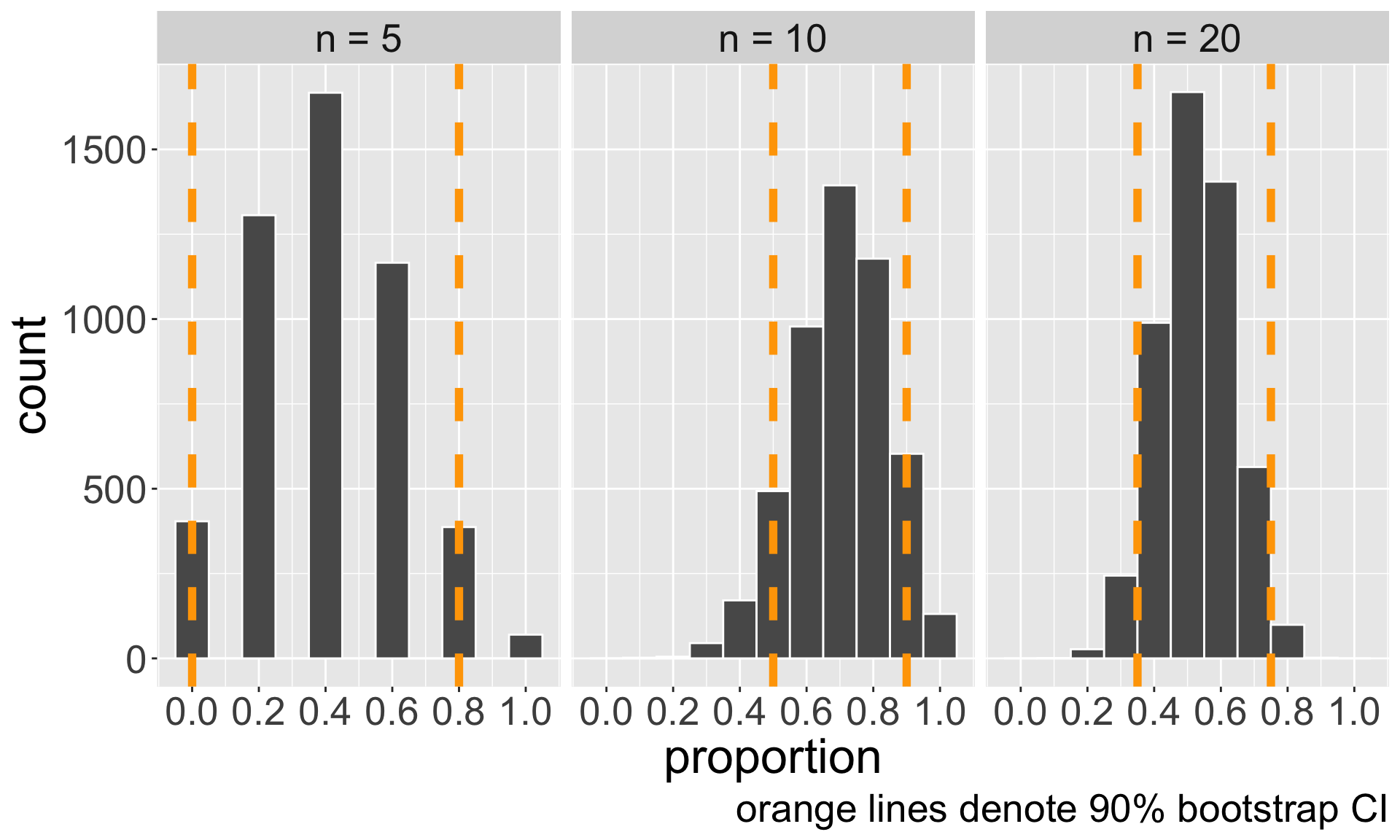
Comparing changes in 90% bootstrap CI for sample sizes \(n = 5, 10, \text{ and } 20\).
n interval
n = 5 (0, 0.8)
n = 10 (0.5, 0.9)
n = 20 (0.35, 0.75)

What do you notice about the bootstrap distributions and CIs as \(n\) increases?

Live code + Coding practice!

  • Live code:

    • in-line code

    • setting a seed

  • You will investigate what happens as we move \(\gamma\) between \(0\) to \(1\)!

In-line code

In-line code allows us to be reproducible! Suppose I do all this analysis:

x <- c("berry", "burry", "berry", "berry", "berry", "bury", "berry", "burry", "berry", "berry")
n <- length(x)
p_obs <- sum(x == "berry") / n
p_obs
[1] 0.7

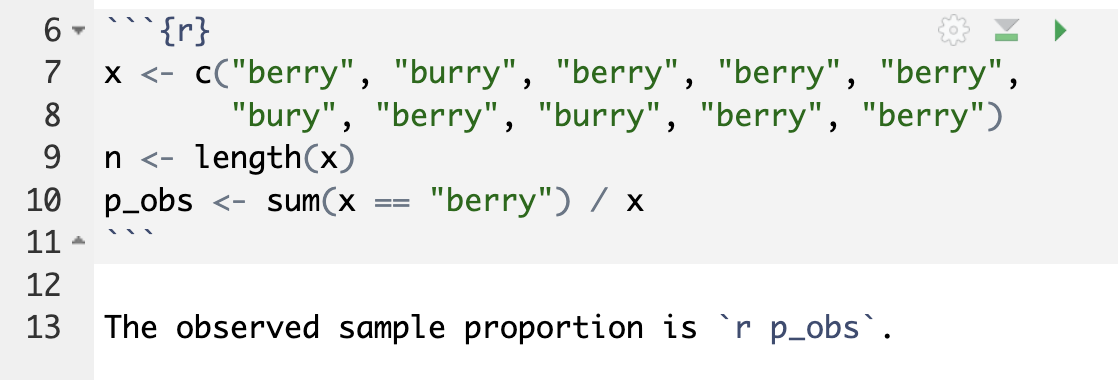
I might want to report this value! Rather than “hard-code” the value 0.7 in the white text of my .qmd, I want the .qmd to update the value dynamically upon rendering!

.qmd file
Rendered PDF
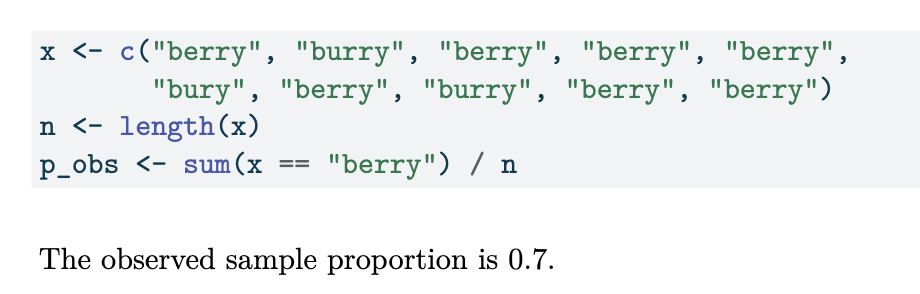
  • Notice the syntax of inline code! Backticks, r, and the spacing matter!

Setting a seed

When we do random sampling, how can we reproduce our results? By setting a seed!

  • “Random” sampling is achieved via a “random number generating function”, which takes in a number as input. Kind of like initializing the randomness.
  • set.seed(<integer>) before doing random sampling will initialize the generator at that specific integer input, so subsequent calls to random number generating functions will produce the exact same sequence of “random” numbers